essay

The Birds and the Trees

The day before the trees came down, I hauled a pile of wooden ladders out of the undergrowth and tried not to think about poison ivy.

I try not to think about a lot of my yard, my home, my self. There’s just too much mess, and try as I might, I can’t seem to keep it all swept up. Even when I do manage to hack back the junk trees and vacuum the living room and floss between my teeth, the weeds and dog hair and plaque always come back before my willpower does.

To some extent, that’s just the experience of being a human in this world. I really am giving it my best. I use a cute little app to remind me to mow the lawn, scoop the cat poop, take my meds. I meet regularly with a therapist who takes my insurance. I dragged the ladders away from the weeds so the tree removers could do their job.

A pair of robins eyed me warily as I shuffled back and forth on that task, wiping cobwebs and desiccated spider corpses off my hands and onto my shorts. One had a dark head and a bright red-orange chest, the other’s colors were grayer, muted. A male and a female. Parents overseeing a nest somewhere nearby?

My own parents have been the ones doing the heavy lifting (literally) at my house lately. The plan is to replace the ancient, leaning garage with a new one at the end of a new concrete driveway (no more mowing the gravel!). While I was comfortably air-conditioned at work, Mom and Dad were gutting the garage, gathering estimates, and even scrubbing the pans that I’d left “soaking” in the sink for lengths of time I won’t admit to here.

My parents have the relentless energy and capability of cartoon superheroes. Dad can master any machine and fix any maintenance mire. Mom can reverse a tornado of mess in minutes and paint a house in an afternoon (to reference The Producers: “Two coats!”).

And me? I can begrudgingly drag a stack of ladders a couple of feet across the yard.

When I finished, I tried to find the nest that the birds were potentially guarding, but the overgrown edges of my yard were too dense to parse. The robins chattered at me from the power lines (that’s them in this essay’s header image) as I strolled the length of my lawn, splitting my attention between the tangled knots of the junk tree canopy and the reaching trios of poison ivy leaves that threatened my bare ankles.

Nothing. If there was a nest, I couldn’t find it. I didn’t know whether to feel relieved or concerned. The entire jungle of my backyard was scheduled to be culled first thing in the morning, and if one of the dozens of vine-choked trees secretly housed a huddle of hatchlings, I wanted to mark it off to keep them safe.

So many critter homes were about to be demolished to improve my own home. Just one more thing to feel guilty about.

In the morning, before I could dare snooze my alarm, a fleet of trucks arrived, lining the narrow neighborhood street and releasing a swarm of men in matching helmets and patriotically-themed UV-resistant uniforms.

Arriving alongside them was my mother in a rainbow of gem tones and a twirl of skirt.

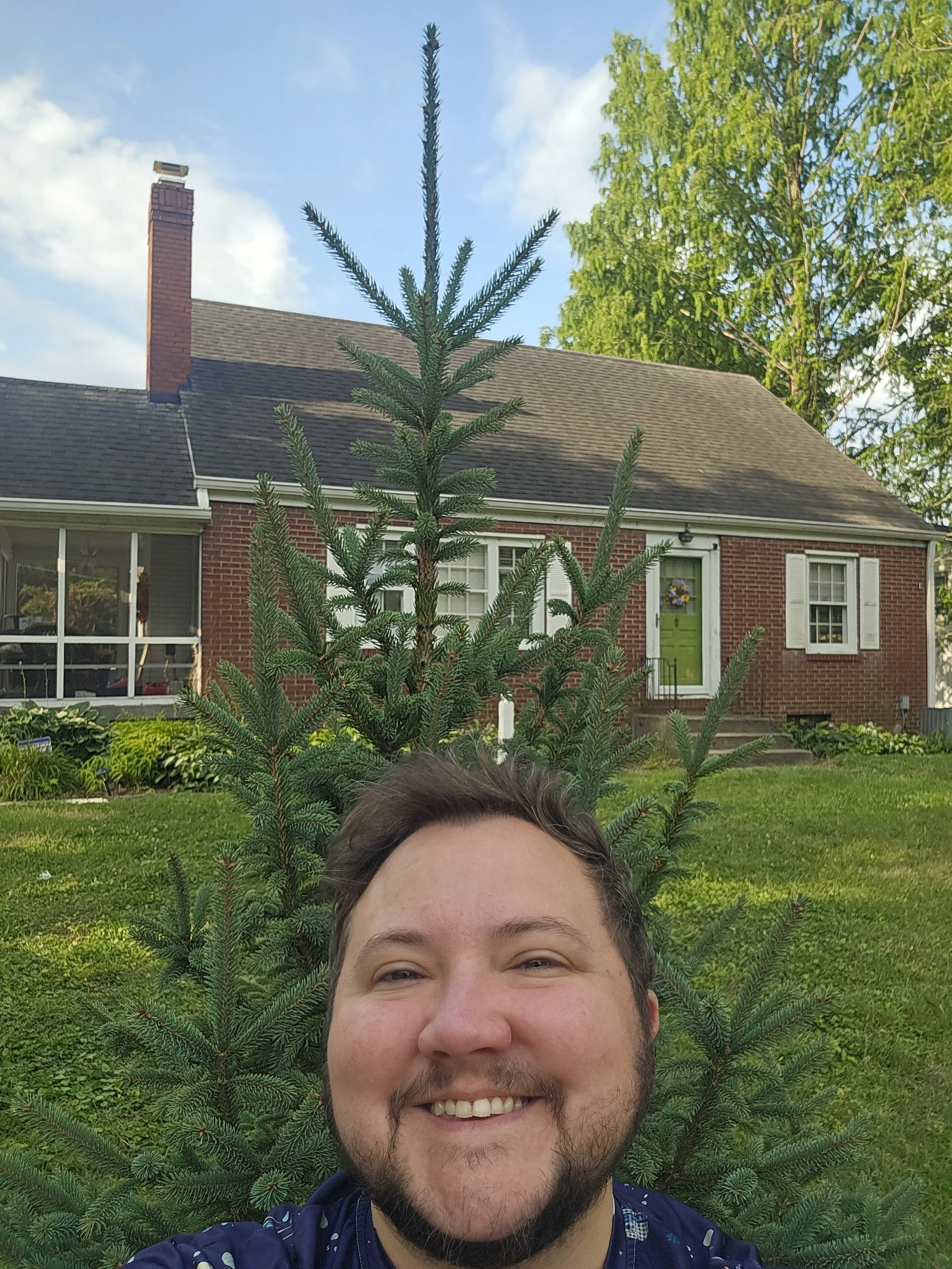
“Not this one!” she joked to the men, pointing with both arms to the spruce I planted eight years ago as they laid out chainsaws and harnesses on the lawn. “That’s Spruce Springsteen!”
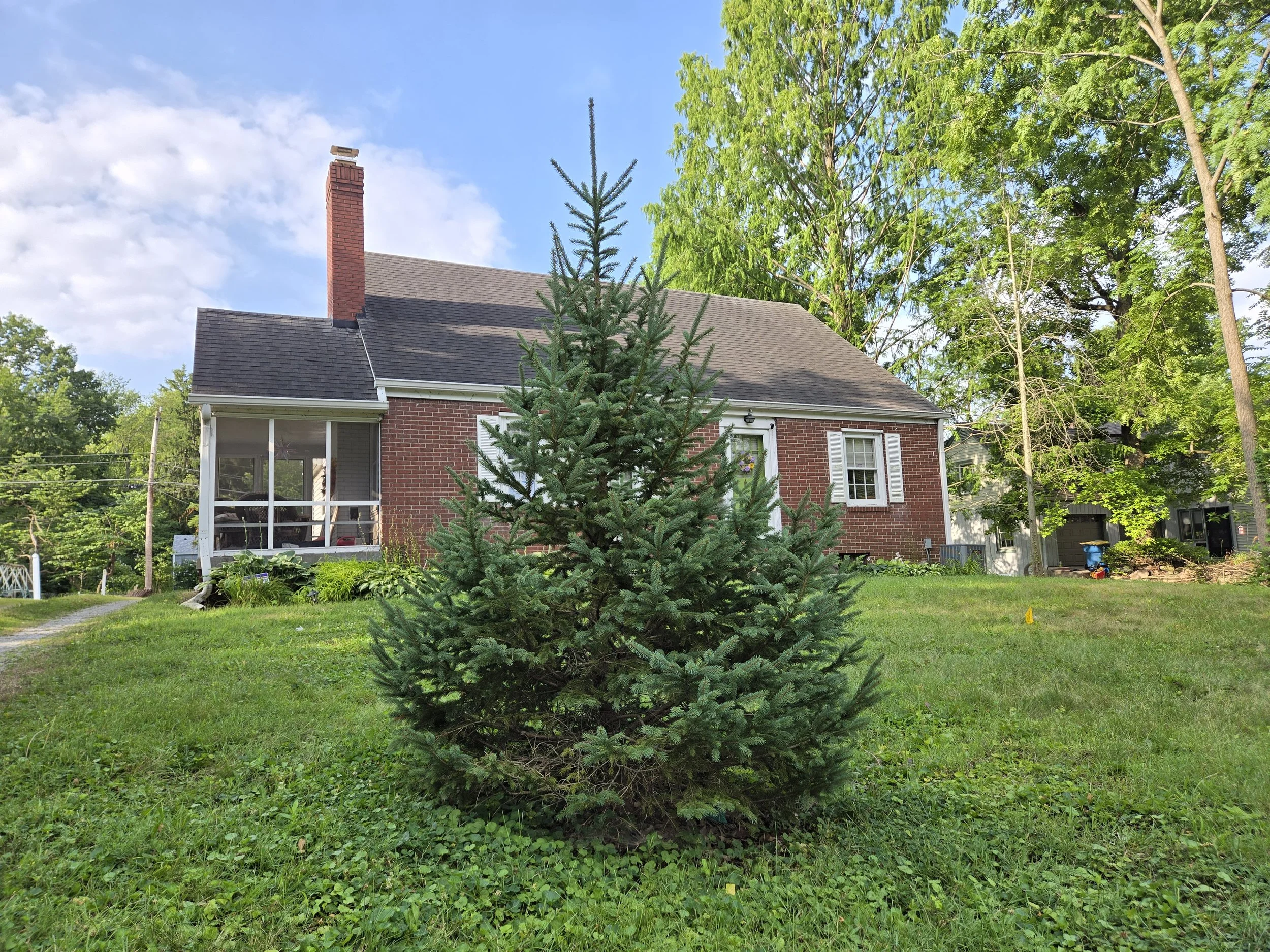
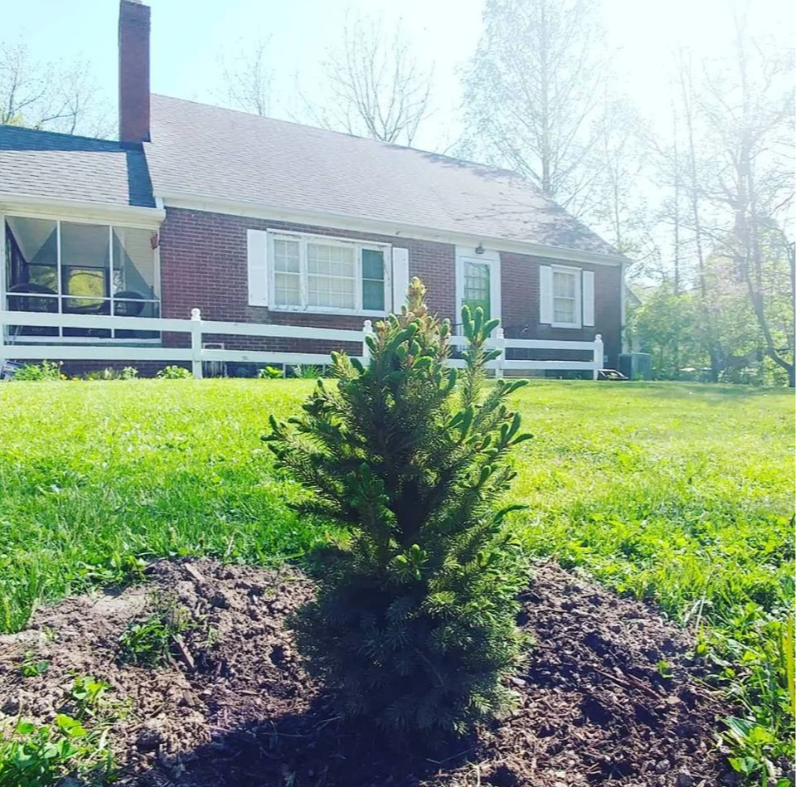
[Pictured above: Spruce now vs. Spruce when I planted him (and blogged about it) in 2018. Also, all 5’2 of me for scale.]

The men were not in a joking mood. As I scrambled to find places to park cars out of the way, the workers slung weighted lines over the high branches of the nearest doomed walnut. They moved with the swift conviction of a platoon of ants en route to a picnic.

Unfortunately, I had my own work to attend to, so I didn’t witness just how quickly my yard was stripped of its decade or more of overgrowth. My mom and an ever-vigilant neighbor friend reported that the job was completed by the early afternoon. By the time I returned from work, everyone and every tree was gone.

Every tree except for two narrow trunks that twisted around and climbed up each other into a shabby spray of leaves and dying vines. There, nestled in the crux of the bonded trees, sat a nest.

The nest had shreds of plastic dangling from it like sickly-white jellyfish tendrils. There was that guilt again, that the wild animals who share my home are suffering because of my presence, or the general presence of humanity. It’s been a little tough to feel warmly towards mankind lately, after all. But it was a solid nest regardless, and I stood still and quiet to watch as the boldly-painted father robin arrived to feed the brood. A cluster of excited triangles bobbled up to meet him, hungry beaks that had survived the surrounding apocalypse.

The tree-cutters had spared them.

Over the next few days, I occasionally checked on the family, despite being swooped at by the parents. I just wanted to make sure they were still there, still OK. At one point, I worried that one of the parents had become sick. I saw the outline of an adult-sized bird, but it was very still, and its red chest was flecked with black. A quick check online reassured me that this was a healthy juvenile, just about ready to leave the nest.
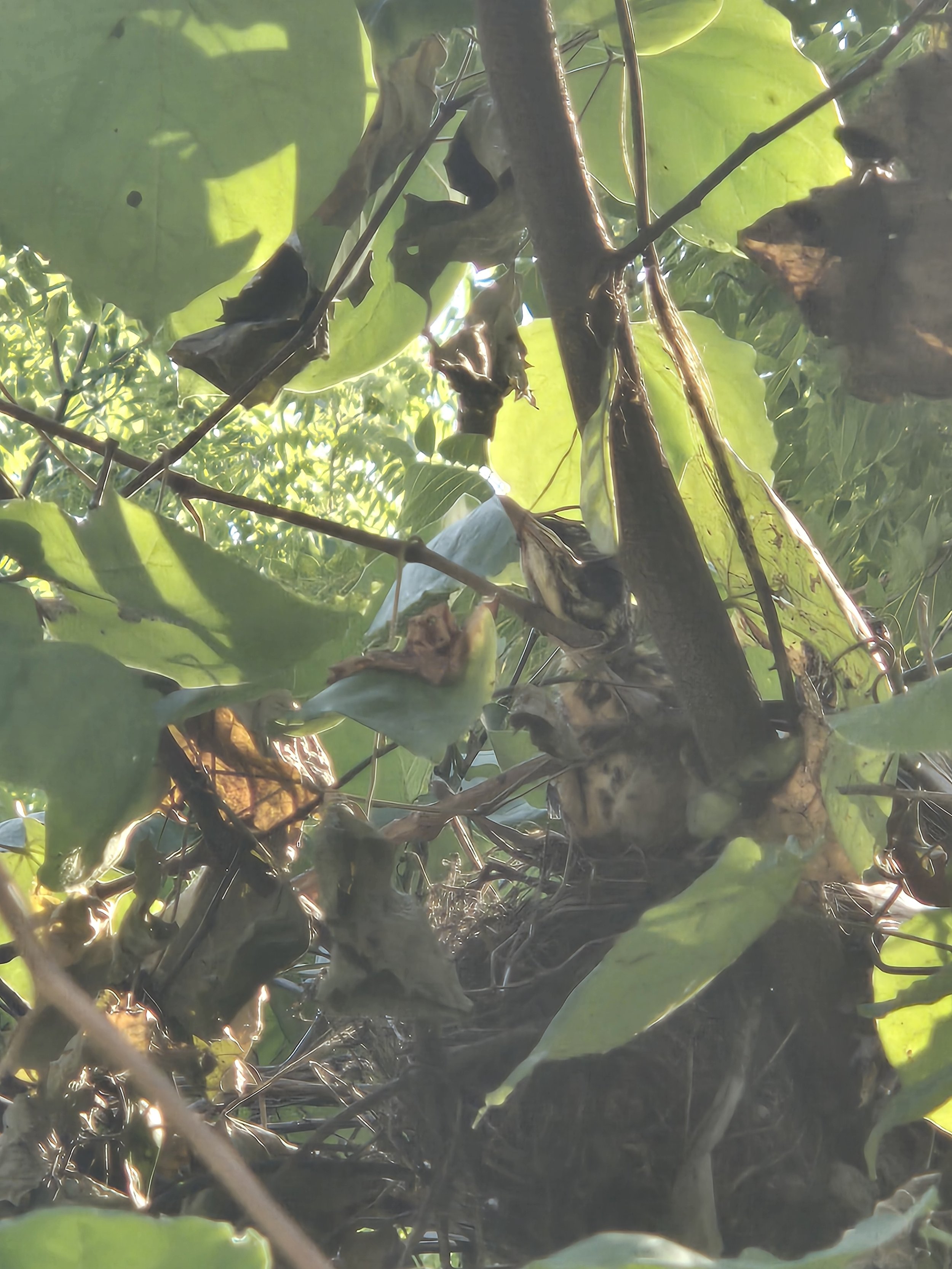
Check out this big blotchy baby.

Which must have happened on a day I didn’t check on them, because the next thing I knew, my dad had returned to cut down the last two trees. He confirmed to me that the nest was empty; the kids had made it, and they’d all moved on.

I was sort of sad to have missed their departure. So much has changed so rapidly. My house looks bald without its cowl of unkempt greenery, and my heart aches for the massive walnut tree that must have been living here since before my great grandparents built the house I now own. When I left for work, that tree towered over my backyard, but when I came home, it was like there was a hole in the sky where its branches were meant to grow.

It’s for the best. This will make my life easier. Happier. I even feel guilty about that. I know the guilt doesn’t help anything, but it adheres to my brain like candle wax on carpet, seeping into every crevice and fiber, hardening by the second. My parents may be superheroes, but I have a superpower too: finding ways to be ashamed about absolutely any- and everything.

For now, the best I can do is meet the guilt with gratitude. I am lucky to have my own pair of robin parents protecting me and my home, even if that home is held together with literal and metaphorical garbage sometimes. I have been spared the overwhelm of navigating all these changes alone. What does it matter if I feel unworthy? The love and support are given freely, generously. I would be rude to reject such a gift.

It will take some time to adjust, but my new view is of a wide and limitless sky, and somewhere in it, young robins are soaring.


Essay: Hyacinth

Someone brought a planter of hyacinths into the office earlier this week, and I've dreamed of my old church for the past three nights.

The powder-sweet smell infiltrated my subconscious, I think. Of all the senses, smell is said to be the most closely bound to memory. Did you know that losing your olfactory abilities could be a predictor of Alzheimer's? Sort of gives another dimension to the phrase, "stop and smell the roses."

I don't need to stop for the hyacinths. They sit above my desk and rain their scent down on me all day. I'll forget it for a time, the way you lose the clean bite of chlorine after a few minutes at the pool. Then, out of nowhere, I can smell them again, so thickly that I inadvertently visualize a fog of yellow pollen coating my sinuses, lining my sticky air tubes, clinging to the wetness of my lungs.

The smell delivers me into the sanctuary, sitting stiffly in a pew, trying to hike up my pantyhose without causing a scene. Glossy black flats bite the backs of my heels. My coat is in my lap, because even though it's Easter and the sun is cutting through the tall windows and threatening to burn the right side of my face, frost had grayed our yard this morning.

There is a problem with the way my memory works. The smell of hyacinths took me to church, but I did not see the purple fireworks of petals on the altar ahead of me. I felt burning sunlight and blistered ankles. 

Not only that, but the memory always spirals off, into the Sunday school room where the smiling, dismissive teacher explains the sin of homosexuality, describing queer people in an abstract, alien way. He says, "there are people out there," not realizing that there are people in here, in his room, trying to love without sacrificing their eternal life. 

But I say nothing.

A friend speaks up, questions whether love could ever be something that deserves damnation. The teacher asks if my friend has something to tell us, and it's a joke, and we're a room of high schoolers, and when the teacher laughs, we laugh.

My friend leaves. I stay. I regret this for years, and I think of it when I smell the hyacinth that should remind me of the arrival of spring and other joys.

That's what my brain does. It shoves aside the good memories as it dives into the depths for the dark and shameful ones. It does this at night as I process my day, repeating and repeating every conversational mistake, every occurrence of unkind thoughts, every real or imagined expression of disappointment from others. It does it when I smell sawdust and remember crying in front of a room of art students because it reminded me of my dead Pappa's barn. It does it when the heat draws up the bitter scent of asphalt and I'm transported to the second before I fainted in high school marching band, collapsing under the drums I'd insisted I was strong enough to carry.

Only with great pressure does my brain retrieve the rest of the memories.

Every kind word I share with my friends, every time I make them laugh. The shrieking joy of invading Pappa's workspace and striking him square in the back with a Super Soaker, of seeing his smile before he's even turned around. The drumline instructor jabbing a finger at the rest of the line and saying:

"Look at her! Look at how hard she works! Look at what she can do! Don't you dare let her down!"

The memories are there, down where the light can't always reach. I have to deliberately draw them up.

So do you.

There's a memory I keep under a glass jar, fending off any darkness that might force its way in. 

It's summer, and I'm on an island in the Great Lakes, peddling a rented bike on hard-packed sand. I'm alone, but in the kind of way where I'm at my most whole. I tour a winery, and I'm too young to drink, so instead of wine I sample Catawba grape juice with a powder-sweet taste. 

I ride past the vineyard that grew the grapes I drank. Rows and rows of vines and bunches of unripe fruit, green clusters of pearls. Hot wind shuffling broad leaves.

I reach the far end of the island and lay the bike against a dune, among hardy purple flowers. Ahead of me, water that could stretch to the end of the world, flecked with sails and diving seagulls, blue and white and flashing. My heart aches, like some force has reached from the lake and into my ribcage, grasping my soul, pulling me forward.

Barefoot, I flinch at the coldness of the water enveloping and then retreating from my toes. 

I walk in, step by measured step, the cold dulling as my skin numbs. The bottoms of my shorts are wet and clinging. An errant wave pushes me up, swallowing my hips, then pulls me further out from the shore. 

I smell the sunscreen washing away from my arms and the damp organic odor of aquatic plants baking on the sand. I smell the green of summer foliage and the fragile perfume of flowering weeds.

I breathe deeply through my nose before I sink beneath the surface.

Psalm of the Kitchen

Every meal is a prayer. I've learned the meditation of a pot of water not yet boiling. I frame the altar of my stove with talismans of spice and oil. The touch of the steam is like the touch of a spirit, warm but fleeting, anointing my palm with moisture that evaporates as I pull away.

The concept of the kitchen as a cathedral is not a new one. We've sensed the spirituality inherent to eating and preparing to eat since our ancestors first stood on two legs and wandered the tall grass, gathering shared resources with evolutionarily repurposed arms. Food unites. Food restores. We are all members of its congregation.

It's as a congregation that my family stands around me in our most ancient sanctuary. I sizzle onions and garlic in a dark pan, and we call out songs to play, a tap away on our phones. The water shushes over plates in the sink as we wash them, and they clink and scrape together, and it's music, too. My sister chops vegetables, shuck, shuck on the cutting board. My love reads instructions to me from that holy tome, the cookbook, and the dogs click claws across the tile. We exist in this moment more than we've existed anytime else in the day. Right now, we are participating in the universe.

Most sacred to me are the times I worship alone. Some of those days, I hear my family in the next room, their voices indistinct and tumbling over each other, lifting in laughter, quieting, continuing. I don't need to know their words. I am satisfied knowing their presence.

Some days, the next room is silent and empty, and I cherish that as well. I whisper invented hymns as the burner tick tick ticks. I rub salt between my fingertips. There is a powdery smell to pasta when it hits the bubbling water, even when it's the cheap macaroni I buy in bulk because I'm afraid of the day that my family will be hungry and our cupboards will be empty. 

But it's not this day. Today, I can fold stringy, melting cheddar into the noodles and add a dash of cayenne, just because I can, just because it's there. Though the meal is cheap, it will taste like a miracle, because my loves will wake up to hot food from their cold sleep.

I pray that I can always do this. I pray that I can protect us with a stirring spoon. I pray that I will always hear voices in the other room. 

We cup warm bowls in our hands and bow our heads. 

The truest god I know dwells in this communion.

Rise Up

Today I sit at my computer, knowing I have much to say, but not knowing how to say it.

Yet.

There are big things to be said. There are things to say about America’s decision to elect a foaming-at-the-mouth racist, a misogynist, a rapist to our highest political office. There are things to say about the culture that would enable this unqualified, unpatriotic bigot to win in a race against the woman who may be the most qualified presidential candidate in the nation’s history. There are things to say about the millions of people who must now wonder whether it’s safe for them to stay in this hostile country anymore.

I sit in front of my computer, typing on a clunky external keyboard because my real keyboard stopped functioning in the middle of the election coverage, and think about how I will be married in 10 days. I am a woman marrying another woman (though there are some wiggly gender things in the mix). I can’t help but Google the ways in which my marriage can be torn apart by humans who can’t believe in the happiness, safety, or dignity of other humans.

I think about the panicking economy. I think about the montage of evil things our new president said about the people he now expects to unite beneath him. I think about my friend’s mother who said, regarding this man’s own vile admissions, “You don’t just let a man stick his hand up your skirt. You defend yourself.” She said this to her daughter, as if she’d forgotten what her own child had survived, as if her baby was the one at fault for the crime committed against her.

There is rage in my throat that will burn me hollow. There is so much to say, so much, and my heart can’t take the strain of it. My jaw aches from gritting my teeth. A new fear wraps thorny vines around my guts as I wonder if I can be brave enough to introduce my wife to people in this country as my wife, not my roommate, not my friend.

My new vice president would sooner see me electrocuted than happily married.

On my wedding day, I will think of that. I know I will.

But I will also think of how this rage can be transformed into energy. An aggressive kindness, an army of love in the face of America’s blind hatred.

Our country will not be the rabid dog that the rest of the world watches with fear, wondering when to put us down. Not with the millions of outraged voices rising up from every corner of the map. Not with the thousands of organizations dedicated to the protection of those who are threatened by the madmen we’ve let into our government.

Lend your strength to the Indiana Youth Group. To Planned Parenthood. To Dayspring Center. To every organization that values the lives that have been jeopardized today. Help the ACLU take Trump to court should he try to implement his most dangerous and unconstitutional proposed policies. Defend your Muslim neighbors. We will save America from the ground up with ferocity and passion and goodness.

May our actions preserve what I still believe is a good and beautiful nation, even as our government eats itself alive. Stand strong. We will be proven right in time, thought it will be a grueling process.

I have so much more to say. I will be among the millions who will act and love and write America back to life.

And so will you.

Essay: The Wind Telephone

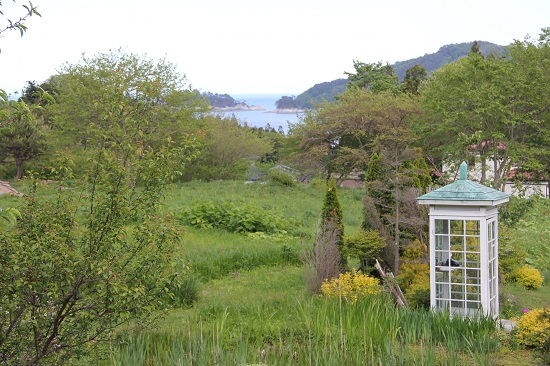
I heard this story on the radio. In Japan, on a hill by the sea, the old, white bones of a phone booth stand. People go there to whisper messages to the dead for the wind to carry away. Little updates, gentle greetings, tears. They call it the Wind Telephone.

So this is my Wind Telephone call.

You aren't dead, but you are a ghost. I can talk and talk and talk to you, but you can't hear me, you're in your own world, your own afterlife. I tell you that I know what it's like, because we've both fallen into Hell, but landed in different circles. I don't know your circle. I just know mine, and every time I think I've trudged out of the tar of it, I find myself still trapped in the mire. So what can I say to you to give hope when I'm still sinking in the muck?

I know what it is to be your own hostage, rattling against your skin-cage, screaming soundlessly like in a nightmare, but you're wide awake. We have different ways of fighting our captors. I'm loud and impulsive and weapon-wielding and chattering. I throw lines into the dark and hope they find purchase. I spill myself in ugly, tumbling words. When I Jekyll-Hyde, everyone knows it. I'm a performer. I'm scared of falling into the black. I'm bright bile green: toxic, searing, but full of energy and expression.

But you don't throw lines. Like they told you to in the movies, you stand still as the quicksand eats you. Your words are weapons that are sharp on both ends. Whether you hold them or share them, they cut. You're the falling House of Usher, a slow crumble inward, a final devastating split on the horizon. You're a purple, appealing poison. You're the color of art in a quiet, shadowed gallery. 

And I don't know what to do, because your monster raises the hackles of my monster, and I'm afraid of letting them get too close. But that's what keeps happening. When I stare the ghost of you in the face, when you're that spectral self, I feel my monster shift and growl under my skin. Because I'm terrified that there's nothing I can do, and fear is my monster's favorite meat. It doesn't matter what chains I've looped around its neck. When it smells my helplessness, when it hears my closest loved ones mention its name and the things it's done, it will claw its way out. Not as powerful as before, but still with those hungry, seeking teeth.

There was another story I read this week. This woman wrote her friend's text messages into an AI, she computed him back to life. A linguistic echo. I can't help but think of your words. They're scattered here and there, extensions of yourself, red and pulsing and alive. No one writes like you. Surprising sets of sounds, details that become the DNA of a character. You write with such visceral physicality. Faced with your ghost, I can find your body in your poetry.

Which is how I wound up here, wind-telephoning. Because I don't know what else to do. Because holding it together isn't always an option. Because I'm afraid of ghosts.

Maybe you won't see this. Maybe you will, and you'll be angry with me. Good. Be angry. Be real. Hear me, talk to me. Let me help. 

Please, return my call. I'm waiting by the phone and listening to the wind.